

| Authority | European Medicines Agency (EMA) |
| Update |
Revised eCTD v4 implementation roadmap |
| What's New? | Updated milestones for the phased transition to eCTD v4 across the EU |
| Scope | New centrally authorised marketing authorisation applications (CAP MAAs) |
| Key Dates: | Voluntary use (Dec 2025) · Strongly recommended (Q1 2027) · Mandatory for new CAP MAAs (Q1 2028). |
The European Medicines Agency (EMA) has published an updated implementation roadmap for eCTD v4, refining the timeline for the transition to the next generation of electronic regulatory submissions.
The updated roadmap confirms that eCTD v4 will become the strongly recommended format for new centrally authorised marketing authorisation applications (CAP MAAs) from Q1 2027 and mandatory from Q1 2028. While the overall direction remains unchanged, the revised milestones provide greater clarity on the next steps towards implementation.
eCTD v4 Timeline at a Glance
| Date | Description |
| December 2025 | Voluntary use of eCTD v4 begins for new CAP MAAs |
| Q1 2027 | eCTD v4 becomes the strongly recommended format for new CAP MAAs |
| Q1 2028 | eCTD v4 becomes mandatory for new CAP MAAs |
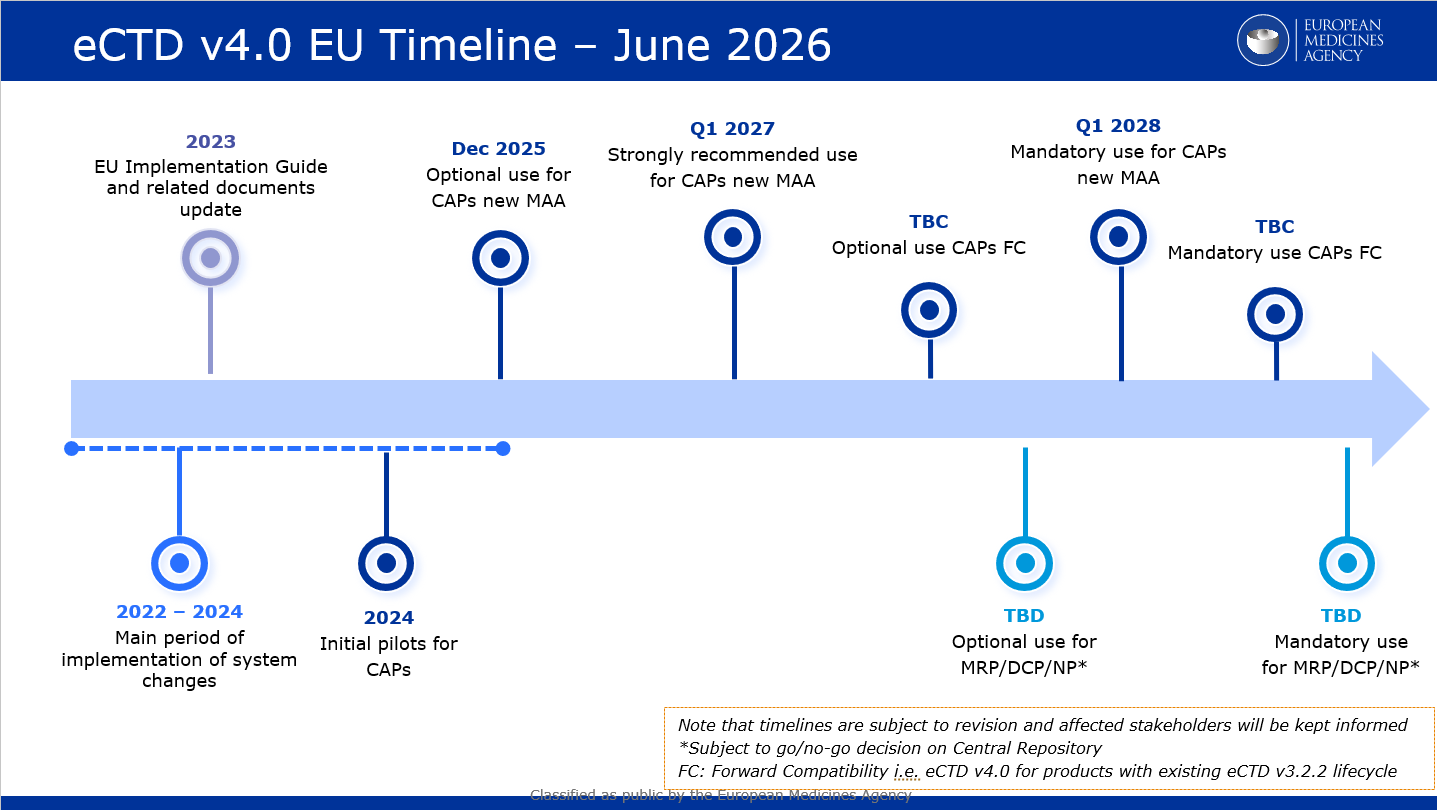
(Source: EMA; eSubmission: Projects)
What is different now?
The updated roadmap builds on the phased implementation approach that the EMA introduced with eCTD v4.
The first phase began in December 2025, when applicants were given the option to submit new centrally authorised marketing authorisation applications using eCTD v4. This voluntary phase remains the same.
The next milestone is Q1 2027. From then on, the EMA strongly recommends that new CAP marketing authorisation applications are submitted in eCTD v4, although eCTD v3.2.2 may still be used during this period.
In Q1 2028, eCTD v4 is planned to become mandatory for all new centrally authorised marketing authorisation applications - the next major step in the European transition towards the new submission format.
The roadmap also confirms that the transition for products with existing eCTD v3.2.2 lifecycles will follow a separate path. Details about this will be communicated as implementation activities continue.
The timeline has changed. The destination hasn't.
The latest update may simply appear to shift a few dates. In reality, it provides more clarity on how the transition to eCTD v4 will progress for new centrally authorised applications. It also reinforces an important message: the destination has not change and eCTD v4 will be the future submission standard for Europe
For Regulatory Affairs teams, this means that implementation planning can continue with a clearer understanding of the next milestones, and organizations gain additional time to assess system readiness and prepare their regulatory data for the new standard. The transition to eCTD v4 is therefore not only about meeting future regulatory requirements; you can also use it as an opportunity to modernize submission processes and strengthen the quality and consistency of regulatory data.
If you like to learn more about eCTD v4 and what your organization can expect from the transition, contact us any time or get our white paper: White paper - eCTD 4.0: Objectives, benefits & impact | EXTEDO

.png)
.png)