

eCTD v4 introduces a new language for regulatory submissions, fundamentally changing how terminology, structure, and data are used compared to eCTD v3. With the transition from eCTD v3 to eCTD v4, many familiar terms are replaced or redefined to support a more data‑driven and modular approach.
Understanding this new terminology of eCTD v4 is a critical first step. These new terms represent a different way of organizing, linking, and maintaining regulatory information. The change in language mirrors the underlying structural and technical evolution of eCTD v4 and lays the foundation for improved lifecycle management, greater automation, and more efficient reuse of content.
This blog post provides an overview of the most important terminology changes and explains how the language of eCTD v4 differs from the concepts used in eCTD v3.
From Dossier to Application
In eCTD v3, regulatory work is centered around the Dossier, which typically represents a single medicinal product and offers limited flexibility for handling variations. With eCTD v4, this concept evolves into the Application.
An Application in eCTD v4 is designed to reflect regulatory reality more accurately. It can cover one or multiple strengths, dosage forms, and active substances. By broadening the scope of what can be represented within a single application, eCTD v4 enables a more holistic and scalable view of product data and aligns regulatory submissions more closely with structured data initiatives such as IDMP.
Regulatory Activity Becomes Submission
Another key terminology change is the shift from Regulatory Activity to Submission. In eCTD v3, a Regulatory Activity represents a grouped regulatory intent. In eCTD v4, this concept is simplified and clarified: the submission becomes the mandatory regulatory interaction.
This change introduces a clearer separation between regulatory intent and the technical building blocks used to deliver content. By defining submissions more explicitly, eCTD v4 improves transparency and consistency across regulatory interactions.
Sequence vs. Submission Unit: A Structural Rethink
In eCTD v3, the Sequence is the central structural element. Sequences are identified by four‑digit numbers - In eCTD v4, the equivalent structural element is the Submission Unit, using a different numbering approach.
The Submission Unit starts with a single‑digit number, beginning at “1”. Maintaining numbering continuity becomes especially important when combining eCTD v3 and eCTD v4 content. This redesigned structure supports more modular submissions and improves consistency across evolving regulatory scenarios.
New Concepts Introduced with eCTD v4
While many lifecycle principles remain familiar, eCTD v4 introduces several entirely new concepts. One notable addition is the Update lifecycle mode, which can be used exclusively for metadata‑only changes. This allows applicants to update document titles or priority numbers without replacing the document content itself.
Two further concepts fundamentally change how submissions are structured: Context of Use (CoU) and Keywords. Context of Use is used to build the submission tree by explicitly linking table‑of‑contents headings with the documents referenced under them. Keywords complement this by adding precision and structure. Used together with Context of Use, Keywords - such as pharmaceutical form or language - help define how documents are placed and interpreted within the submission.
The new Terms in eCTD v4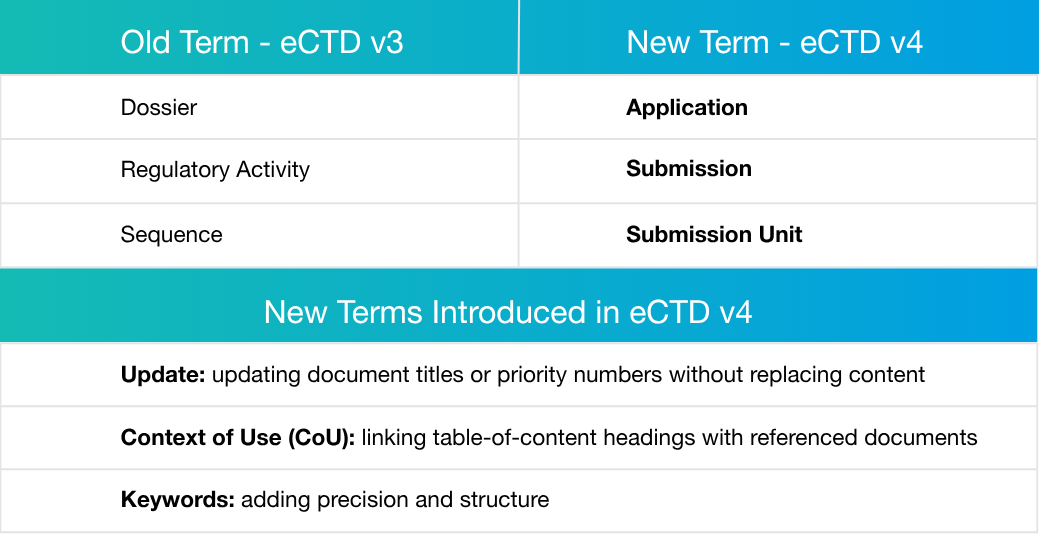
Why This New Language Matters
These terminology changes are not merely stylistic. They reflect a strategic shift toward:
- Greater reuse of content
- Better alignment with global data standards
- Improved lifecycle management
- Increased automation and validation consistency
Organizations that treat eCTD v4 as “just another format” risk underestimating its impact. Understanding - and adopting - the new language early is essential for efficient implementation, especially when operating parallel eCTD v3 and eCTD v4 submissions. Forward compatibility enables this transition by preserving lifecycle integrity and minimizing duplication.
Preparing for eCTD v4
Learning the new terminology is the first step toward successful adoption. Regulatory teams should now:
- Familiarize themselves with eCTD v4 structures and concepts
- Review internal processes and training materials
- Assess how applications, submissions, and submission units map to existing portfolios
eCTD v4 is not just a technical transition. It is a shift in how regulatory information is structured, understood, and communicated - and mastering its language is key to unlocking its benefits.
Are you ready for eCTD v4? Forward compatibility is the key to navigating the move from eCTD v3 to v4. Read our previous posts about the full journey - from the basics and underlying mechanics to a step‑by‑step implementation guide, including a closer look at the EMA’s pilot program for early validation:
Forward Compatibility in eCTD v4 – The Bridge to eCTD v4 | EXTEDO
Forward Compatibility in eCTD v4 – Your Organizational Roadmap and the EMA Pilot | EXTEDO


.png)

.png)